Portable Hardness Testing: Fact vs. Fiction
Hardness testing decisions often rest on assumptions, and some of them are decades old. Here is what is actually true about portable Brinell testing, reading Brinell impressions, verifying your tester, and King Pin® testing, from the company that has built the King Portable Brinell Tester since 1936.
The King Portable Brinell Tester
A tester light enough to carry can't deliver a full Brinell load.
The King Portable Brinell Tester weighs 38 pounds and delivers a full 3000 kg load. Bench testers that apply the same load weigh upward of 1,000 pounds. The King brings full-load Brinell testing to the part, instead of bringing the part to the lab.
Portable equipment won't hold up in the field.
The tester is built from stainless steel, with alloy-steel elevating screws and a cast stainless-steel test head. King testers have worked in foundries, forge shops and oil fields since the 1930s, in heat, in cold, and at nearly any angle, including upside down.
One portable tester should handle every test load.
King calibrates testers to a range of force loads, and each tester releases at one specific load. That single-load design is what makes every test on that tester repeatable. Operations that test at two loads run a dedicated tester for each.
Parts too large for a portable tester have to go to a bench unit.
Interchangeable bases and test head configurations let the King tester reach tall and wide parts, and the Chain Adapter applies a full load to parts of various diameters wherever they sit. Additional adapters test inside pipes and hold the test head upright on drill presses and boring mills.
A portable Brinell tester needs frequent repair.
The King tester is built to last for decades, and most service needs trace back to operating technique rather than the tester itself. The Stroke Limiter and Bleeder Valve guard against pump-segment and test-head damage, and the Preventative Maintenance Package keeps testers in service year after year.
Sending a tester in for calibration means going without one.
King's loaner program keeps you testing while your tester is in for repair or calibration . Contact the service department before shipping to arrange a loaner.
Calibrating my own tester is as good as a certified calibration.
An in-house adjustment won't carry ISO/IEC 17025 certification. King Tester is an A2LA-accredited ISO/IEC 17025 calibration laboratory, and King Portable Brinell Testers are certified to ASTM E10 with traceability to NIST. E10 is a tighter standard than ASTM E110, the standard written for portable testers. That is the documentation auditors look for.
Brinell Scopes
Any Brinell microscope can read any Brinell impression.
ASTM E10 defines two classes of measuring device. Type A devices, with movable measuring lines or image analysis, can be used with every ball size. Type B devices, with fixed measuring lines, are used for larger-ball impressions and are not permitted for 2.5 mm or 1 mm ball impressions. King offers both: the KingScan® V and KingScope™ 100 are Type A, and the KingScope™ remains the industry's preferred Type B handheld reader.
Two trained inspectors will always read the same impression the same way.
With a manual scope, the human eye and judgment play a large role in the result. The KingScan® V removes that variable: it captures the impression digitally, evaluates it from multiple angles, and calculates the Brinell result in under 5 seconds with no operator bias. McInnes Rolled Rings standardized readings across its inspectors with the KingScan® V, then ordered two more units.
Automatic Brinell reading means a computer, cables and a lab bench.
The KingScan® V is an all-in-one handheld unit weighing under 3 lbs. Align it over the impression, press the button, and the result is calculated, stored with a timestamp and ready to export, with no external computer. A quick daily check on the included test block confirms accuracy.
Only an automatic scope gives a precise reading.
The KingScope™ 100 reads to 0.01 mm in a rugged, handheld Type A design, with a small nosepiece for tight spots, fast focusing, and a built-in LED for low light.
Reading an impression in a tight recess means grinding the part first.
The KingScope™ has a 20X pre-focused lens and a narrow nosepiece that fits into tight recesses, so there is less grinding on castings, billets and dies. A slip-on base adapter adds stability for flatwork, and a pen flashlight attachment handles dim conditions.
Test Blocks
My test block has to match my part's hardness exactly.
A test block verifies the force your tester applies, and the tester applies the same force regardless of the block's hardness. A block within about ±20 HBW of your target hardness is sound practice, and tighter ranges are available on request. Read more on choosing the right test block .
All Brinell test blocks are basically the same.
King test blocks carry a patented, laser-etched alphanumeric grid with indentation spacing that complies with ASTM E10, section 7.7. Every impression lands in the right place and gets a unique identifier, which makes daily verification records easy to keep and easy to audit.
Daily verification costs too much to do every day.
Test block traceability is just paperwork.
Every King block is individually serialized and traceable, meeting ISO/IEC 17025 requirements. That is the chain an auditor follows from your daily check back to the national standard. Register your block 's serial number to keep records organized and receive a discount on your next order.
The King Pin Tester®
Brinell testing a large or fixed part means bringing in heavy equipment.
The King Pin Tester® brings Brinell testing to large or fixed components with no air supply and no setup. Load a King Pin®, strike once, measure the impression with the included LED magnifier, and read hardness from the table. It's trusted by foundries, forge shops and oil field QC teams.
King Pins® aren't tied to the HB scale.
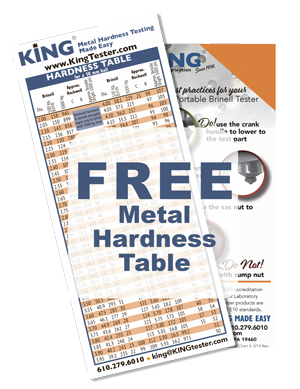
Every bag of 250 King Pins® includes a hardness table for fast BHN lookup, and King Pins® are manufactured to less than 1% tolerance. Subscription ordering keeps you stocked for regular testing.
It takes a strong operator to get an accurate King Pin® reading.
The calibrated King Pin®, not the operator's swing, sets the test force. Operator strength is not a factor in an accurate reading.
Portable Rockwell & Case Depth
A portable Rockwell tester can't be held to a recognized standard.
The ePortaRock is certified to ASTM E110, the standard written specifically for portable Rockwell and Brinell testers, which uses the same test principles as ASTM E18. The ePortaRock H delivers a 100 kgf load, and the ePortaRock L delivers 5 kgf for softer metals and finished surfaces, reaching tight and narrow test spots.
Measuring effective case depth has to be slow and destructive.
Effective case depth measurement used to take 45 to 60 minutes. The CaseRock Series measures it in about one minute, nondestructively, with no test piece preparation. That productivity gain is what makes the CaseRock an investment rather than a cost.
Still have a question?
Talk to a King technical representative at (610) 279-6010 , or tell us about your application and our team can help you determine the right hardness testing solution.